
Community-Led Behaviour Change for Safe Motherhood
Community-led behaviour change is making a difference in strengthening maternal health in Nepal. Through the enhanced Community-Based Health and First Aid (eCBHFA) approach, Red Cross volunteers — neighbours and relatives within the community — visit households to facilitate birth preparedness, health, and hygiene. Through these visits, families are enabled to plan ahead and reduce risks around pregnancy and childbirth. Women like Preeti and Sobina show how small changes can open the way to safer motherhood, while local governments now see behaviour change as a practical tool for healthier communities. The experiences from Nepal show how Behavior Change Interventions (BCI), rooted in everyday life, can strengthen health when it grows from daily practices and is carried by the community.
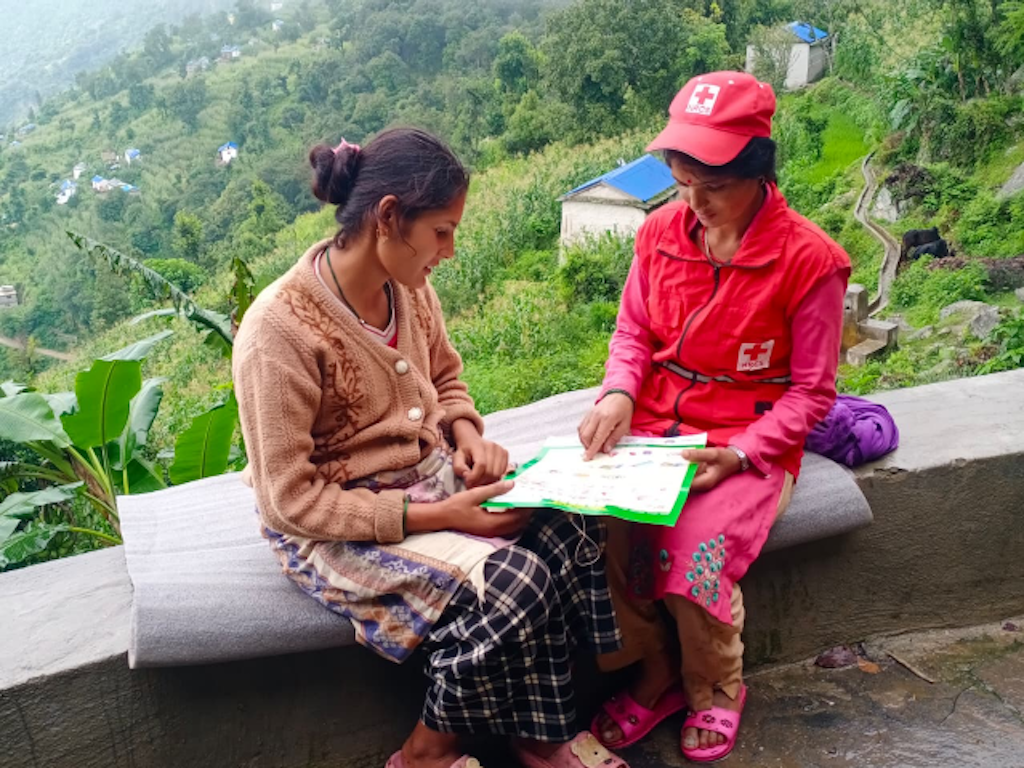
From Uncertainty to Confidence: Preeti’s Path to Safe Delivery
Expecting her first child, Preeti is on a journey filled with new experiences and important decisions.
She moved to Sanni Triveni, a rural municipality in Kalikot, Nepal, nine months ago after her marriage, settling into a traditional earthen house with her husband and in-laws. Rice and maize fields surround the home, with fruit trees growing just outside.
When she learned she was pregnant, Preeti wasn’t sure where to begin. That started to change when a Community-Based Health and First Aid (eCBHFA) volunteer from the Nepal Red Cross, a young eager woman from the community and a distant relative, began visiting her regularly. A sense of trust grew quickly, turning each visit into something Preeti looked forward to.
“She explained why birth preparedness is so important and helped me choose the hospital where I could deliver.” Now, Preeti goes for regular checkups, knows where she will give birth, and has arranged transportation in case she cannot reach the nearby health post on foot once labour pain starts. She has also begun taking iron and folic acid supplements and plans to go for blood group testing after learning that this service was recently introduced at the local health facility.
The volunteer didn’t just speak with Preeti; she also engaged her in-laws. Preeti, in turn, shared what she had learned with her family. “We discussed things at home afterwards,” she said. “Then we agreed to start saving money for the delivery.” But that wasn’t all. Encouraged by the volunteer, she joined the local Health Mothers’ Group and soon learned about a Safe Motherhood Revolving Fund, created and managed by the women themselves, which helps cover delivery costs. “In the meetings, we talk about hygiene, nutrition, and how to take care of the baby. I didn’t know most of these things before.”
Preeti's daily routine has changed as well. In the beginning, her family knew she was pregnant but still expected her to work in the fields. After the volunteer explained the risks, that changed. Now all family members understand why she shouldn’t do heavy work, “and they’ve accepted it.”
Looking back, Preeti describes her experience as a process, one that started with new information, turned into action, and became something shared and supported by others around her.
“Without the visits, I think I might have just done what my in-laws did, giving birth at home. That’s how it’s always been. People used to die from it. But now I know I am prepared, and my child and I can feel safe.”
Behaviour Change in eCBHFA: A Community-Led Approach
The enhanced eCBHFA approach, developed by IFRC, builds on years of Red Cross’ community health experience. It is a participatory way of working that enables communities to identify their own health risks, take collective action, and strengthen everyday behavioural practices in health, hygiene, and first aid.
At its heart are Behaviour Change Interventions (BCI). These are not about telling people what to do. They are about understanding why people act the way they do; knowledge, social norms, cultural beliefs, emotional drivers, and practical barriers that shape behaviour. Based on the COM-B Model by Michie and Stralen (2011), interventions are designed to respond to these determinants, making healthy choices both realistic and acceptable.
The Swiss Red Cross (SRC) has made BCI a core strength for National Society Development (NSD). In Nepal, this expertise took root through the EACH (Enabling Action for Community Health) Project, implemented by the Nepal Red Cross Society (NRCS) with support from the Swiss and British Red Cross. The project reaches four rural municipalities in Karnali and Lumbini Provinces.
It began with tailored guidance and training for NRCS teams, who then passed their knowledge on to colleagues and, in turn, to more than 250 eCBHFA community volunteers. What started with a handful of trained staff quickly grew into a movement owned by the communities themselves. Today, Red Cross volunteers sit in kitchens, courtyards, and fields — talking about and facilitating actions on safe water, sanitation, family planning, and birth preparedness in ways that are practical, personal, and closely connected to daily life.
Why Birth Preparedness Matters in Nepal
Despite significant progress, maternal mortality remains a challenge in Nepal.
According to the new report Trends in Maternal Mortality: 2000 to 2023, published in April 2025 by WHO, UNICEF, UNFPA, the World Bank Group and UNDESA, Nepal’s maternal mortality ratio has declined to 142 per 100,000 live births, a 71% drop since 2000. Progress has been substantial, but it still falls short of Nepal’s own national targets of 116 by 2022 and 99 by 2025.
Behind these numbers lie the difficult realities many rural families continue to face. Health facilities are often far away, blood banks are often lacking, skilled health workers are not always present, and transport in emergencies is rarely guaranteed. Even when services exist, families may struggle with the costs or with knowing how to access them, and the choice to seek care is often influenced by long-standing social expectations.
As Sobina, a mother in Kalikot (Karnali) now pregnant with her second child, explained: “Last time, I tried to hide the pain. I only told my family at the last moment, and by then it was too late, I delivered on the way to the birthing centre, carried on a stretcher. This time, I will call for a stretcher in time. I feel better prepared now. The visits from the volunteers gave me the courage to make my own decisions. But I still want to learn more, so I hope they visit me more often.”
Sobina’s experience reflects life in one of Nepal’s most disadvantaged districts, where services are scarce and traditions shape decisions. Her story shows how the support of volunteers can change behaviour around birth preparedness and why it matters that families are able to plan early, before emergencies leave them with little time to act.
Building Change from Within
Over the past 15 months, more than 250 eCBHFA volunteers — neighbours, relatives, friends, or simply community members — have visited households in their own communities, reaching 14533 households, including 774 pregnant women. Change, however, does not end at the household level. It grows when families come together in Health Mothers’ Groups, Senior Citizens’ Groups, or other community forums. In these spaces, people discuss, support each other, and find collective solutions — from saving funds to sharing knowledge on pregnancy, hygiene and safe use of water. These networks help make changes in a social context and owned within the community.
But change also takes longer than a single project cycle. For it to last, local governments are crucial partners. EACH is jointly implemented with them, and local leaders have voiced their appreciation of the approach. One chairperson observed, “We see changes in the communities. Some time ago, when visiting households and asking for water, I would be given untreated water. Now I get filtered water.” On birth preparedness, he highlighted that “practices are changing and being accepted.” One of the wards (an administrative unit of the municipality) in Lumbini Province has recently been declared as a “Zero Home Delivery Ward” reflecting changes and commitments from the local authorities to improve maternal health, including birth preparedness.
Local governments increasingly position themselves as key actors in sustaining behaviour change. One municipal chairperson remarked: “We are responsible for changing the behaviour of the community.” Their interest goes beyond participation — many seek to deepen their understanding of BCI and to embed ownership within their own systems. This reflects the way SRC’s expertise is cascading outward: from technical support to NRCS, to communities through volunteers, and now into municipal structures. Local governments recognize that sustaining volunteer engagement and using their broader networks — including schools — are critical pathways for scaling the approach.[CP1]
A Way Forward
Reducing maternal mortality requires stronger health systems and effective governance. Yet the experiences from Nepal show that preparing for birth is not only a medical matter, but also one of behaviour, support, and ownership. Community-driven behavior change is a vital piece of the puzzle. The experiences of women like Preeti show that change begins in households and communities, where exchange, support, and courage open space for moving beyond the familiar, strengthening safety in birth and health in everyday life.
Women’s names are changed for the purpose of anonymity.