
Sustainability Robotics as a new field of research: The foundations of a new scientific discipline
Dübendorf, 13.07.2026 — Climate change, resource consumption, and the energy crisis pose major challenges for our society. Robotics could make a significant contribution to addressing these challenges – but researchers believe this will require a shift in thinking. In a manifesto published in the journal Nature Machine Intelligence, they propose a new scientific discipline: Sustainability Robotics. In future, robots should not only become more efficient and intelligent but also be specifically designed and deployed to contribute to environmental, social, and economic sustainability.

Robotics and (physical) artificial intelligence (AI) are advancing rapidly. At the same time, global challenges such as climate change, loss of biodiversity, and resource scarcity are intensifying. While robotics has so far been guided primarily by criteria such as precision, speed, and autonomy, researchers are now asking a very different, more fundamental question: What role should robots play in building a sustainable future?
The peer-reviewed article was published in the journal Nature Machine Intelligence and authored by a group of international experts from leading universities and research institutions: Mirko Kovač from Empa and EPFL in Switzerland, Barbara Mazzolai from the Italian Institute of Technology (IIT) in Italy, and Sukho Song from the Daegu Gyeongbuk Institute of Science and Technology in South Korea. Song also previously served as a Group Leader at the Laboratory of Sustainability Robotics at Empa. They propose the creation of a new scientific discipline: “Sustainability Robotics”, aimed at evaluating robotic systems not only based on their technical performance but also on their impact on the environment, society, and the economy.
“Until now, robotics has focused primarily on what machines can do,” says Kovač, head of the Laboratory of Sustainability Robotics at Empa and EPFL. “The next step is to ask what role robots should play in building a sustainable future.”
More than just “green robotics”
Sustainability already plays an important role in the field of “green robotics.” However, the authors of the manifesto take a decisive step further. In their view, it is not enough to merely reduce the ecological footprint of robots. Rather, robotics must actively contribute to solving sustainability challenges. “Our goal is not simply to make robots more sustainable,” says Kovač. “We want to establish Sustainability Robotics as a distinct scientific discipline.”
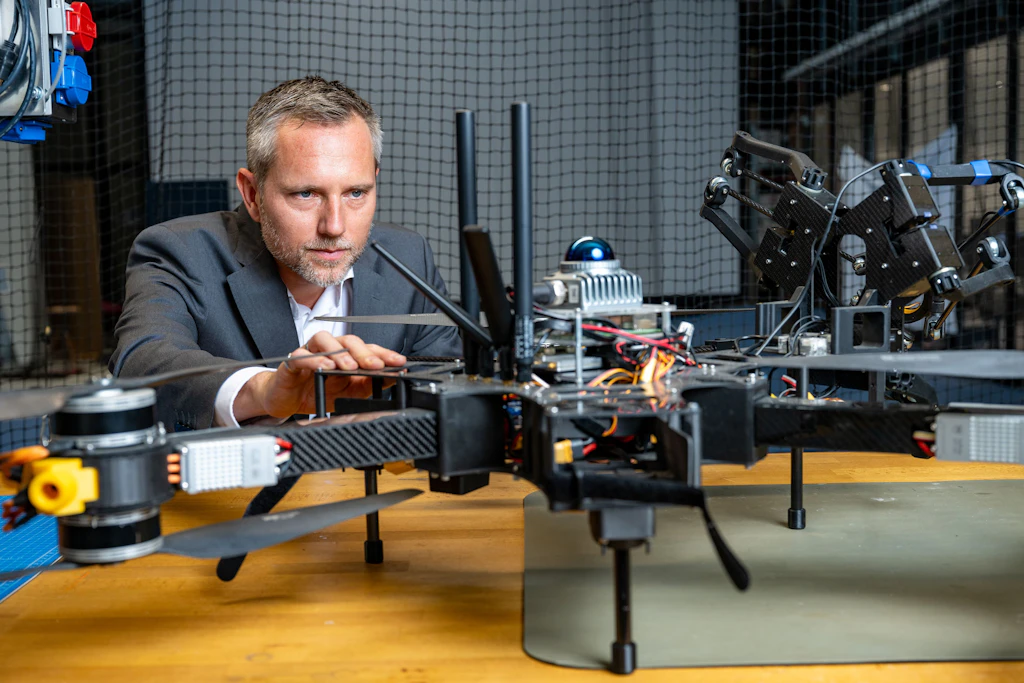
In this regard, the researchers distinguish between two complementary goals: On the one hand, robots themselves should become more sustainable – for instance, through the responsible use of materials, a circular economy, and lower energy consumption. On the other hand, robotic systems should be specifically deployed to monitor environmental changes, support disaster response efforts, or maintain critical infrastructure. Possible applications range from biodegradable drones and air-water robots for monitoring ecosystems to flying robots for inspecting hard-to-reach infrastructure.
Barbara Mazzolai, who is Associate Director for Robotics at IIT, underlines the importance of sustainability in the full life circle of robotics: “We should draw inspiration from living organisms, which are able to achieve remarkable functionalities while minimizing energy and material consumption.”
Guiding principles for the robotics of tomorrow
At the heart of the manifesto are three guiding principles. Robotic systems should be minimally invasive, universally accessible, and symbiotic. Minimally invasive robotics should minimize environmental, biological, and societal impacts as much as possible. This includes, for example, energy-efficient systems, compostable electronics, or robots that can be repaired and reused. Universal accessibility means that robotics should not benefit only affluent regions or specialized industries. Technologies should be affordable, maintainable, and usable even in places where they are most urgently needed.
The researchers attach particular importance to the concept of symbiosis. Robotics should not only perform individual tasks efficiently but also create the greatest possible benefit for people, the environment, and the economy. “The most important question is not whether a robot is technically advanced,” says Kovač. “What matters most is: Who benefits from it – and what impact do these autonomous systems have on our planet?”
For example, automated systems could in future monitor damaged coral reefs and support their regeneration. In contrast, there are applications such as robotics for deep-sea mining, whose ecological consequences may well be viewed critically. For the researchers, this comparison shows that what matters is not solely what robots are technically capable of, but rather the purpose they serve and the relationship they establish with their environment. “We use the term ‘symbiotic’ because we want to develop robotics beyond mere efficiency and resource use toward regeneration, responsibility, and mutual benefit,” explains Kovač.
From vision to practical application
The ideas outlined in the manifesto are already shaping research both in Switzerland and in Italy, thanks to the commitment of Mirko Kovač and Barbara Mazzolai. Similar efforts are undertaken at DGIST. The lab combines robotics, Physical AI, materials science, and environmental science to develop mobile robotic systems for distributed environmental monitoring and autonomous manufacturing in complex natural environments. Key research areas include bio-inspired robotics, multifunctional hardware, and multimodal locomotion. With this interdisciplinary approach, Kovač’s team aims to translate the principles of sustainability robotics into concrete technologies while simultaneously advancing research, teaching, and international collaboration in this new field of research.
These activities are complemented by the Competence Center for Sustainability Robotics (CCSR). Currently being established at Empa, the competence center is supported by the Canton of Schaffhausen and promotes research, innovation, and collaboration to further advance sustainability robotics.
In the long term, sustainability in robotics should become just as much a given as safety standards are today. “The success of sustainability robotics is not measured by how many robots we build,” Kovač is convinced. “What matters is the positive contribution these systems make to ecosystems, infrastructure, and people’s quality of life.”
Literature
M Kovač, B Mazzolai, S Song: A Manifesto for Sustainability Robotics; Nature Machine Intelligence (2026). doi: 10.1038/s42256-026-01260-6
Further information
Prof. Dr. Mirko Kovač
Sustainability Robotics, Empa & EPFL
Phone +41 58 765 46 89
info@sustainability-robotics.ch