
ERC Grant for Empa researcher Dorina Opris: Developing fluorine-free transducers for the market
Dübendorf, 11.06.2026 — Storing energy, moving robots, detecting vibrations: The innovative silicon materials developed by Empa researcher Dorina Opris can do all this – and much more. She has now received a Proof of Concept Grant from the European Research Council (ERC) to bring the materials from the laboratory to market.
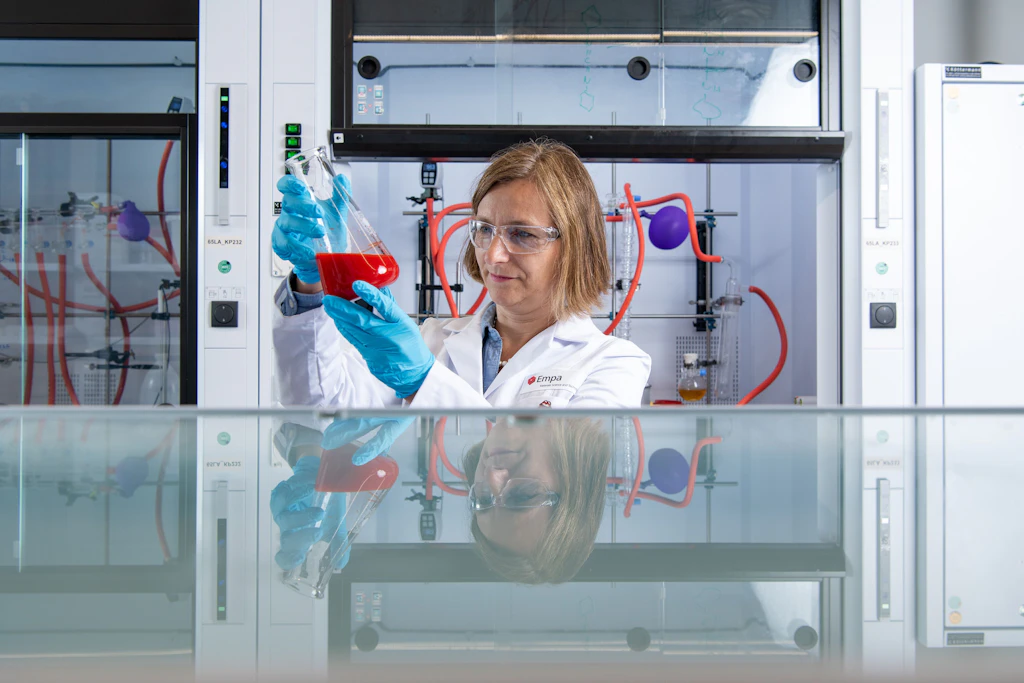
Even if we are not aware of it, we are surrounded by transducers, or energy converters. They are found everywhere where energy is generated, stored, or consumed in any form, for example in electrical appliances, cars, power plants, solar cells, and batteries. The types of transducers and the materials they are made of are as diverse as their areas of application. Empa researcher Dorina Opris from the Functional Polymers Laboratory focuses in particular on materials for soft transducers. Elastic materials with specific electrical properties are suitable, for example, for the manufacture of sound and vibration sensors or artificial muscles, known as actuators, which set mechanical components in motion.
A polymer frequently used for such applications is polyvinylidene fluoride (PVDF). This fluorine-containing plastic belongs to the PFAS group, which are also known as forever chemicals due to their high stability in the environment. With increasing regulation and impending bans on PFAS, sustainable, scalable, and economical alternatives are being sought.
This is precisely where the research of Dorina Opris and her team comes in. The Empa researcher is developing so-called polysiloxanes – or, to put it more simply, silicones. Unlike conventional silicone, the polysiloxanes developed at Empa are polar and function as so-called dielectrics: materials that do not conduct electricity but interact with electric fields. When an electric voltage is applied, they can deform reversibly – in other words, convert electrical energy into motion.
Opris already received a prestigious ERC Consolidator Grant in 2020 for the development of these novel polymers. Now, the ERC is recognizing her research with a follow-up Proof of Concept Grant. This funding aims to facilitate the transfer of technology from research to industry.
Flexible and sustainable
“Our material does not contain any fluorocarbon bonds, and its production does not generate any solvents or ozone-depleting substances, as is the case with PVDF,” says the Empa researcher. Although producing the silicon-based plastic is energy-intensive, the material can be fully recycled. Opris and her team are developing it primarily in the form of printing inks, which ensures simple and easily scalable processing.
The novel polysiloxane cannot replace PVDF in each and every application – the electrical properties of the two materials are too different. However, for certain applications, polysiloxane is an even better fit: It is significantly more elastic than PVDF, even at lower temperatures. This enables better actuators, especially for outdoor use. Opris sees further applications primarily in robotics, the automotive industry, and energy storage. “Because we can process our material into thin films, it can be used in batteries, capacitors, and electronic components, for example,” explains the polymer expert.
No matter how good a new material may be, the step from the laboratory to the marketplace is always a challenge. “Industrial scaling requires investment. However, companies often perceive this step as too risky,” says Opris. Over the next 18 months, the researcher plans to use her ERC grant of around 150,000 euros to create prototypes of dielectric thin films and characterize them in detail – and thus convince industry partners of the new material's potential. Founding a spin-off to commercialize the new materials is another option.
Technology Briefing: Safe and Sustainable by Design (SSbD)
On June 25, the Technology Briefing on “Safe and Sustainable by Design” (SSbD) will take place at Empa in Dübendorf. Researchers from Empa and industry partners will provide practical insights and use concrete examples to demonstrate the opportunities SSbD offers for safe and sustainable innovations. The event is organized by the Empa-Akademie, will be held in German, and is free of charge. You can register at the following link: www.empa-akademie.ch/ssbd
Informationen
Prof. Dr. Dorina Opris
Functional Polymers
Phone +41 58 765 43 04
dorina.opris@empa.ch