
Pollution from aircraft
Villigen, 12.05.2026 — During takeoff and landing, planes emit ultrafine aerosol particles. Some particles also contain lubricating oil, as shown by measurements made by researchers from the Paul Scherrer Institute PSI in the environs of the Zurich Airport. Low-sulphur fuels could be the solution.
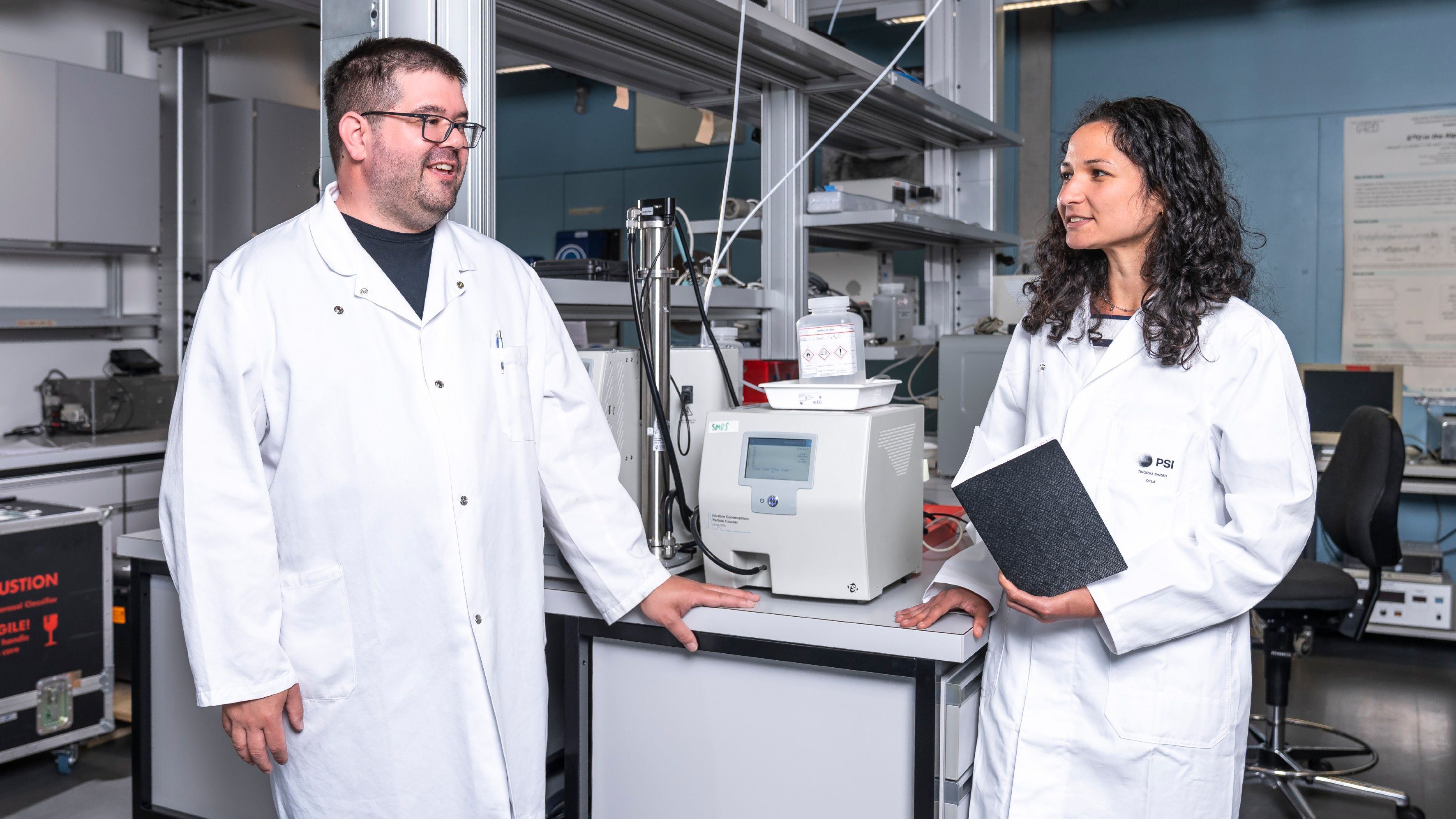
PSI researchers conducted air quality measurements in the area surrounding Zurich Airport in the winter of 2022 and the summer of 2024. In these two measurement series, each lasting several weeks, they used special equipment to capture particulate matter in the air approximately one kilometre downwind from runway 28, the airport’s busiest. They then analysed the particulate matter in near-real time, that is, immediately after capture, using spectrometers to determine particle size and chemical composition. This approach has the advantage over previous studies of this type – which collect data throughout the day and only measure it later – of revealing the influence of changing wind directions or current aircraft approach patterns. Thus the sources can be mapped more precisely.
The measurements confirm findings already obtained from several other European airports, such as Amsterdam and Frankfurt: During takeoff and landing, aircraft especially emit ultrafine particles (UFP) with sizes below 100 nanometres from their engines. These are a mixture of solid soot and volatile sulphate particles produced during the combustion of fuel in the turbines and in the subsequent cooling of the exhaust gas. The researchers detected up to 300,000 UFPs per cubic centimetre of air. This is more than ten times the normal background level at the airport at night when no aircraft are operating.
In cities, typical UFP measurements range from about 5,000 to 40,000 particles per cubic centimetre of air, significantly lower than the values measured at the airport. However, urban air contains a larger proportion of the coarser particulate matter categories below 2.5 and below 10 micrometres. “So in terms of particle mass, the particulate matter pollution at the airport is lower than in the city, where it originates mainly from road traffic, heating systems, and industry,” says study author Sarah Tinorua from the PSI Center for Energy and Environmental Sciences. “But the number of particles at the airport is significantly higher.” This is relevant to human health, since smaller particles, when inhaled, can penetrate more deeply into the fine branches of the lungs. This is therefore a meaningful distinction for airport workers and the nearby residents.
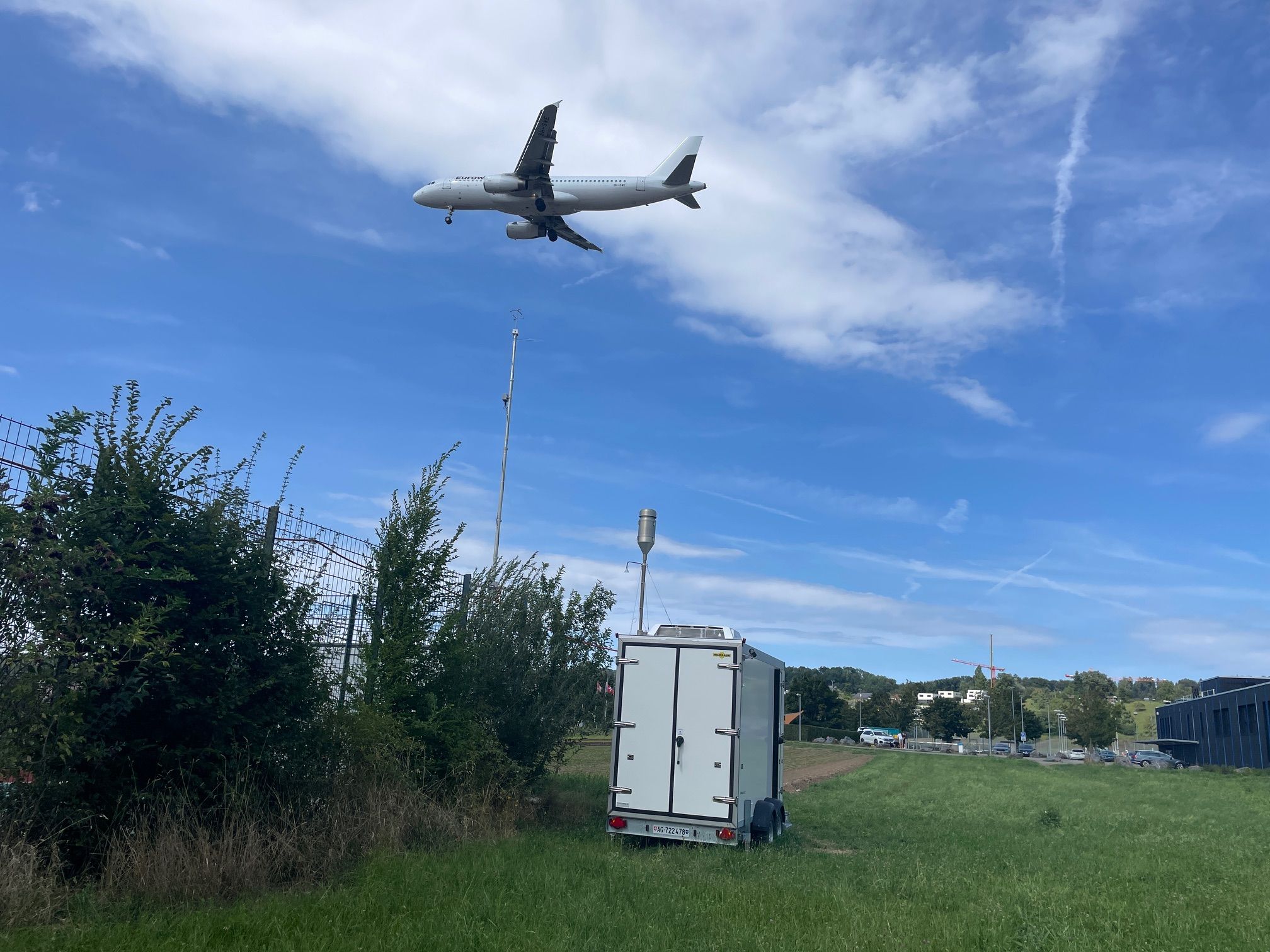
Every plane brings a surge of particulate matter
The researchers had more or less expected to see the high concentration of ultrafine particles at the airport. What is new about their study is primarily that they also detected, for the first time, lubricating oil adhering to the ultrafine particles. “A previous study at Frankfurt Airport had already found lubricating oil in the particulate matter. However, in that study, the particles were collected and daily average values were determined,” reports study leader Benjamin Brem, also from the PSI Center for Energy and Environmental Sciences. “We, on the other hand, recorded measurements of the lubricating oil in real time, that is, immediately after a plane had flown by.” Every time a plane flew over the measuring station at an altitude of around 80 to 100 metres, the researchers recorded a sharp increase in the UFP concentration. “This is because the turbine exhaust gases are forced downwards behind the wings by the downdraft – essentially, directly into the funnel of our capture device,” explains Brem. Only at altitudes above 300 metres are such peaks no longer detectable, as the particles disperse rapidly in the air, depending on the wind, and no further exchange takes place with air at ground level.
Wind also proved to be an important influencing factor: The peaks were more pronounced during landings than during takeoffs. They only occurred strongly during takeoffs when the wind blew the UFP cloud from the runway to the measuring station. Furthermore, the counts of fine particles were higher when measured in strong winds, since in light winds particles clump together more easily over time, forming larger clusters.
The fact that aircraft emit primarily ultrafine particles is due to the relatively complete combustion of fuel in the hot gas turbines compared to other kinds of engines. “However, aircraft engines are optimised for high-altitude flight,” says atmospheric chemist Brem. This means that combustion on the ground during takeoff and landing is less complete and consequently produces more particulate matter. Evidently, some engines are also releasing lubricating oil residue – a semivolatile organic compound – into the exhaust. The measured values can be clearly attributed to airport influence and elevated particle concentrations. “The potential health effects of such lubricants being inhaled deep into the lungs have not yet been fully investigated,” says Tinorua. As a precautionary measure, in any case, it is imperative to eliminate such emissions as much as possible.
Previous measurements taken directly at the engines showed that lubricating oil emissions do not occur in all aircraft types. Their occurrence could therefore depend on the engine design or its maintenance status.
Countermeasures are already being tested
The Swiss Federal Office of Civil Aviation, which funded the study, has shown great interest in the results. They are already being discussed in international working groups to examine potential measures for reducing emissions, particularly from lubricating oil. The Office has been promoting and funding research on ultrafine soot and sensible emission limits for years. According to Brem, the introduction of low-sulphur kerosene would also be an obvious solution. The higher the sulphur content of a fuel, the more particulate matter is produced – volatile pollutants, in particular, are largely attributable to sulphur compounds. Kerosene is one of the few fuels used in transportation for which no strict limits currently exist.
It would also be conceivable to use electric tractors to move aircraft from the taxiway to the runway before takeoff, or to the gate after landing. This would considerably reduce the amount of kerosene subject to incomplete combustion.
Zurich Airport has already implemented various measures to reduce particulate matter emissions as much as possible. For example, the operation of aircraft auxiliary power units to generate electricity after the engines are shut down is prohibited. Instead, aircraft must use the airport’s power supply provided at the gate.
In the long term, according to Brem, the increased use of synthetic kerosene – so-called sustainable aviation fuel (SAF) – could also help. How this fuel can be produced efficiently and in an environmentally friendly way has been the subject of active research at PSI for years. The advantage of SAF compared to fossil kerosene with regard to particulate matter is that it contains no sulphur and fewer undesirable soot precursors. As a result, it burns cleaner, producing less soot and other components of particulate matter.
Text: Jan Berndorff
About PSI
The Paul Scherrer Institute PSI develops, builds and operates large, complex research facilities and makes them available to the national and international research community. The institute's own key research priorities are in the fields of future technologies, energy and climate, health innovation and fundamentals of nature. PSI is committed to the training of future generations. Therefore about one quarter of our staff are post-docs, post-graduates or apprentices. Altogether PSI employs 2300 people, thus being the largest research institute in Switzerland. The annual budget amounts to approximately CHF 450 million. PSI is part of the ETH Domain, with the other members being the two Swiss Federal Institutes of Technology, ETH Zurich and EPFL Lausanne, as well as Eawag (Swiss Federal Institute of Aquatic Science and Technology), Empa (Swiss Federal Laboratories for Materials Science and Technology) and WSL (Swiss Federal Institute for Forest, Snow and Landscape Research).
Contact
Dr. Sarah Maimiti Tinorua
PSI Center for Energy and Environmental Sciences
Paul Scherrer Institute PSI
+41 56 310 23 26
sarah.tinorua@psi.ch
[English]
Dr. Benjamin Tobias Brem
PSI Center for Energy and Environmental Sciences
Paul Scherrer Institute PSI
+41 56 310 24 65
benjamin.brem@psi.ch
[German, English]
Original publication
Ubiquity of Aviation Ultrafine Particles and Lubrication Oil Compounds near Zurich Airport
Sarah Tinorua, Benjamin T. Brem, Zachary C.J. Decker, Jay G. Slowik, Peter A. Alpert, Markus Ammann, André S. H. Prévôt, Michael Bauer, Suneeti Mishra, Michael Götsch, Joerg Sintermann, Martin Gysel-Beer
Environmental Science & Technology, 23.04.2026 (online)
DOI: 10.1021/acs.est.5c18458
To the original text:
https://www.psi.ch/en/news/media-releases/pollution-from-aircraft