
Spintronics plus quantum: PSI researcher receives major grant
Villigen, 03.09.2026 — Giacomo Sala is combining two previously separate disciplines of physics: the established field of spintronics and the emerging field of quantum geometry. His Q-GEOMSPIN project at the Paul Scherrer Institute PSI could pave the way for more efficient data storage – and is now being funded with approximately CHF 2.2 million by the European Research Council (ERC).
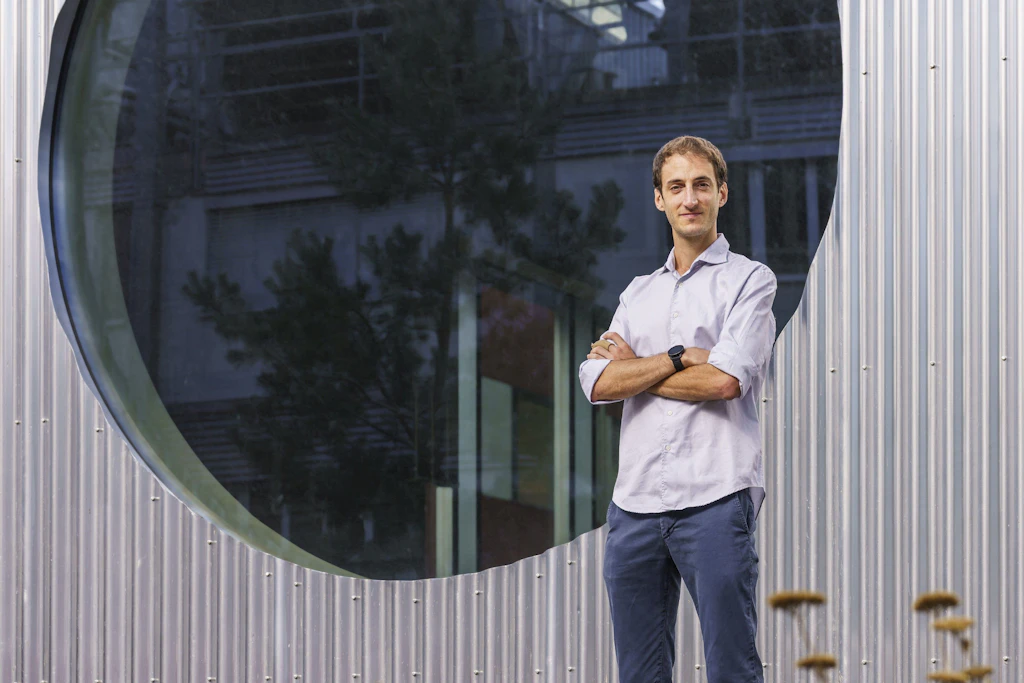
PSI physicist Giacomo Sala has been awarded one of the coveted grants from the European Research Council (ERC) – a so-called Starting Grant. The ERC is supporting Sala’s Q-GEOMSPIN project with € 2.3 million (approximately CHF 2.2 million) over the next five years. Because Switzerland has been fully associated with the EU’s research funding programmes again since the end of 2025, Sala is receiving this funding directly from the ERC.
What is exceptional about Sala’s approach is the combination of two research areas – spintronics and quantum geometry – into a new field of research. The insights gained from this could open up new possibilities for spintronic data storage in the long term. In addition, they could help make it possible to harvest small amounts of energy and to develop new material properties.
The idea for Q-GEOMSPIN arose during two stages in Sala’s scientific career. During his doctoral studies at ETH Zurich, he explored spintronics and magnetism. Later, as a postdoctoral researcher at the University of Geneva, he turned to quantum geometry. Combining these two perspectives led him to the question of whether quantum geometry might give rise to previously overlooked spintronic effects. “As far as I know, up to now no one has linked these two fields experimentally,” says the experimental physicist from the PSI Center for Neutron and Muon Science.
A blank spot on the spintronics map
Spintronics is an established scientific field that has been in existence for 30 years. A Nobel Prize in Physics awarded in 2007 for research in this area underscored its significance. Spintronics takes advantage of the spin of electrons – their intrinsic rotation – to store information.
In recent years, however, it has become clear that there is still a gap in the understanding of spintronics: work in theoretical physics suggests that certain spintronic phenomena could be predicted, understood, and controlled using the emerging field of quantum geometry. Specifically, this involves a subfield of quantum geometry: quantum metric.
To illustrate the concept of quantum metric, Sala uses an analogy: gravity. The gravitational force causes the earth to orbit the sun. According to Albert Einstein, however, the correct explanation is a curvature of space caused by the mass of the sun. “It’s similar for electrons when they move through a solid,” Sala says. As a result of quantum metric, momentum space is curved. The electrons “sense” this and are deflected accordingly.
With the newly awarded funding, Giacomo Sala will be able to employ two doctoral candidates and one postdoctoral researcher. Together with this small team, he will investigate topological materials, among other things, within the framework of Q-GEOMSPIN. Topological materials are solids that are insulators in their interior but conduct electricity on their surface. Also on the programme are oxide compounds and two-dimensional so-called van der Waals materials such as graphene.
Synchrotron light and nanotechnology: PSI offers the infrastructure needed
Sala and his team will fabricate and measure structures that are only a few micrometres in size. These samples are to be cooled to near absolute zero (-273.15 degrees Celsius). For this purpose, PSI is acquiring, with ERC funding, a special cryostat: a cooling device that also generates strong magnetic fields. Inside it, an electric current is passed through the sample, and the deflection of the electrons is measured. The researchers are specifically looking for nonlinear effects, where small variations in voltage or magnetic field lead to large changes in the measurement. They expect these deviations to provide clues about quantum geometry.
Sala’s decision to come to PSI for his project is largely due to its strategic research focus and unique infrastructure. Various lines of research by different groups at PSI converge in its new Quantum Matter and Materials Center, QMMC for short. Q-GEOMSPIN fits perfectly into this new hub for quantum research.
PSI offers all of the facilities Sala and his team will need to produce and characterise materials, manufacture microdevices, and conduct measurements at low temperatures. Among other resources, the team will use the Swiss Light Source SLS and the new PSI cleanroom PICO, managed by the Nanotechnology research group, which is ideally suited for manufacturing the tiny components. PSI’s Swiss Spallation Neutron Source SINQ could also offer interesting possibilities for their research.
Q-GEOMSPIN could finally bring about a major breakthrough for spintronics. Up to now, with the exception of giant magnetoresistance, which was discovered in the 1980s and soon thereafter multiplied the storage density of computer hard drives, commercial applications have been rare. Higher-performance spintronic memory (MRAM) or computer processors that operate on the model of the brain are now on the wish list. Even exotic ideas such as harvesting energy from unused Wi-Fi radio waves are being discussed. Giacomo Sala remains realistic: “Q-GEOMSPIN is purely fundamental research. But that is important, in order to develop applications from it.”
Text: Bernd Müller
About PSI
The Paul Scherrer Institute PSI develops, builds and operates large, complex research facilities and makes them available to the national and international research community. The institute's own key research priorities are in the fields of future technologies, energy and climate, health innovation and fundamentals of nature. PSI is committed to the training of future generations. Therefore about one quarter of our staff are post-docs, post-graduates or apprentices. Altogether PSI employs 2300 people, thus being the largest research institute in Switzerland. The annual budget amounts to approximately CHF 450 million. PSI is part of the ETH Domain, with the other members being the two Swiss Federal Institutes of Technology, ETH Zurich and EPFL Lausanne, as well as Eawag (Swiss Federal Institute of Aquatic Science and Technology), Empa (Swiss Federal Laboratories for Materials Science and Technology) and WSL (Swiss Federal Institute for Forest, Snow and Landscape Research).
Contact
Dr. Giacomo Sala
PSI Center for Neutron and Muon Sciences
Paul Scherrer Institute PSI
+41 56 310 48 70
giacomo.sala@psi.ch
[English, French, Italian, German]