
Newly discovered protein conformation offers a potential target for cancer drugs
Villigen, 21.07.2026 — Several types of cancer are triggered by mutations in a protein called BRAF. Researchers at the Paul Scherrer Institute PSI have resolved a previously unknown conformation adopted by this protein during cell proliferation. Their study, which has now been published in the journal Molecular Cell, opens new avenues for cancer treatment.
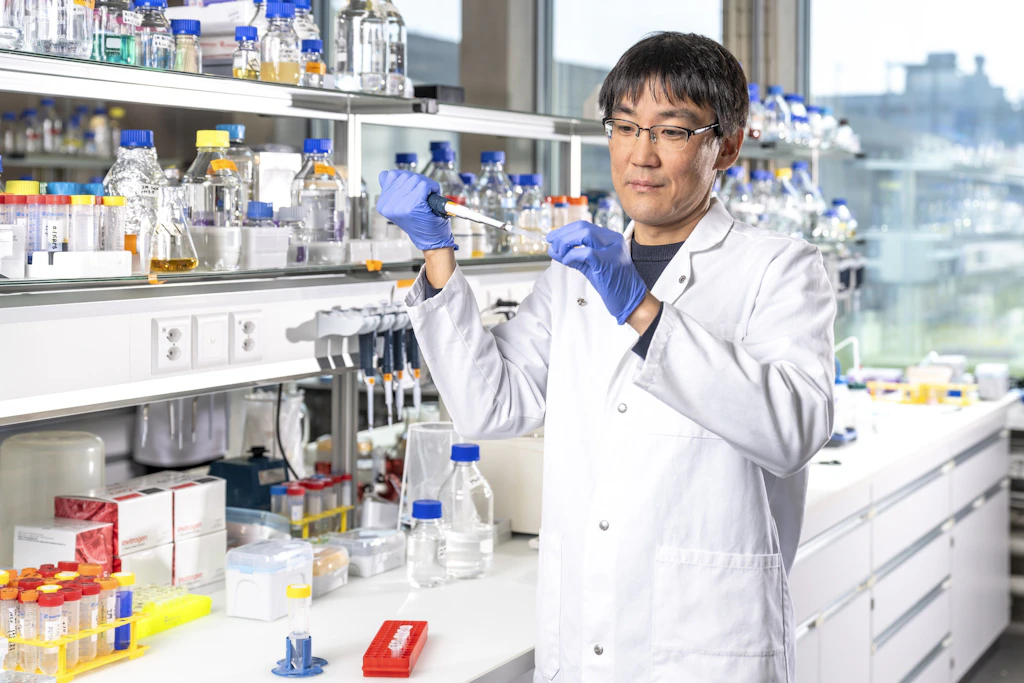
Malignant melanoma is one of the most dangerous forms of cancer. Around half of melanomas and about seven percent of all other cancers carry a mutation in a protein called BRAF. This mutation disrupts the regulation of cell division, causing cells to multiply in an uncontrolled manner. Researchers at PSI and the University of Zurich have now examined the BRAF protein in greater detail, thereby gaining valuable insights into its complex regulation.
“Cancerous tumours affected by BRAF mutations are considered particularly aggressive and difficult to treat,” says Yasushi Kondo, a researcher at the PSI Center for Life Sciences and lead author of the new publication. There are currently very few active substances available for the targeted treatment of these tumours – and, what’s more, the cells typically develop resistance to these drugs after a few months.
A traffic light that’s always green
Proteins change shape and bind to other proteins and molecules to trigger signalling cascades. The BRAF protein is part of a key signalling pathway in all human cells that functions like a series of traffic lights and regulates cell growth and division. On receiving the appropriate upstream signal, two BRAF proteins bind together to form what is known as an active dimer, giving a green light to the next switch. Without the earlier signals however, the traffic comes to a halt.
Mutated BRAF breaks this control. Instead of waiting for instructions, it turns the traffic light green and remains in this state – irrespective of the rest of the traffic network. This sends the cells a constant signal to proliferate, driving uncontrolled tumour growth.
Scientists already knew that a specific short section of the BRAF protein, known as the NtA sequence motif, plays a crucial role in this cancer-promoting process. Now, Kondo’s team of researchers has succeeded in establishing the role of the NtA motif in greater detail.
They did this by investigating the molecular structure of BRAF dimers at the Swiss Light Source SLS at PSI and at the Diamond Light Source in Didcot, England, and carried out experiments in human cells at the University of Zurich.
The researchers discovered a previously unknown form of BRAF dimer that forms during the signalling cascade. This consists of two BRAF proteins of different shapes, whereby the NtA sequence of one BRAF extends towards its partner in such a way that it forms a kind of bridge connecting the two.
An intricate structure
The researchers did not examine this asymmetric BRAF dimer in isolation, but rather in its intricate linkage with another protein called MEK1. “This interaction with MEK1 is a crucial step in the signalling cascade leading to cell division,” explains Kondo. This is because the MEK1 protein subsequently moves on, thereby giving the next green light in the signalling chain.
“In this study, we succeeded for the first time in producing a high-resolution visualisation of the exact structure of this complex in its active, working form, which consists of the two BRAF proteins linked asymmetrically via NtA and the MEK1 protein,” says Kondo.
This is helpful for drug development: targeted therapeutic agents work by binding to the active components of a signalling pathway, thereby interrupting signal transmission. This sets one of the ‘traffic lights’ to red and prevents further cell division in the tumour. “The more precisely we know the structure of these components, the more precisely we can design drugs that fit perfectly.”
More options for cancer treatment
The researchers hope that a wider range of more effective therapeutic agents targeting BRAF will become available in the future. “This would give us more options when resistance sets in,” says Kondo.
In fact, the researchers at the PSI Center for Life Sciences are already searching for molecules that bind to the newly characterised BRAF-MEK1 complex and could thus interrupt the unwanted signalling. “Our findings open up new possibilities for developing drugs that target BRAF in new, different ways,” explains Kondo. “Having a broader range of compounds could provide more options for treatment and help address the diverse ways in which cancers evade existing therapies.”
The current study was supported by the Swiss Cancer Research Foundation.
Text: Dirk Eidemüller, Paul Scherrer Institute PSI/Laura Hennemann
About PSI
The Paul Scherrer Institute PSI develops, builds and operates large, complex research facilities and makes them available to the national and international research community. The institute's own key research priorities are in the fields of future technologies, energy and climate, health innovation and fundamentals of nature. PSI is committed to the training of future generations. Therefore about one quarter of our staff are post-docs, post-graduates or apprentices. Altogether PSI employs 2300 people, thus being the largest research institute in Switzerland. The annual budget amounts to approximately CHF 450 million. PSI is part of the ETH Domain, with the other members being the two Swiss Federal Institutes of Technology, ETH Zurich and EPFL Lausanne, as well as Eawag (Swiss Federal Institute of Aquatic Science and Technology), Empa (Swiss Federal Laboratories for Materials Science and Technology) and WSL (Swiss Federal Institute for Forest, Snow and Landscape Research).
Contact
Dr. Yasushi Kondo
PSI Center for Life Sciences
Paul Scherrer Institute PSI
+41 56 310 47 98
yasushi.kondo@psi.ch
[English]
Prof. Dr. Jörg Standfuss
PSI Center for Life Sciences
Paul Scherrer Institute PSI
+41 56 310 25 86
joerg.standfuss@psi.ch
[German, English]
Original publication
Mechanism of MEK1 phosphorylation by the N-terminal acidic motif-mediated asymmetric BRAF dimer
Y. Kondo et al.
Molecular Cell, 21.07.2026
DOI: 10.1016/j.molcel.2026.06.039
To the original text:
https://www.psi.ch/en/news/media-releases/combating-cancer-growth