
NCDs in Albania: Important Steps Towards Better Prevention and Management
Non-communicable diseases (NCDs) like cardio-vascular diseases, diabetes, and chronic respiratory conditions have become a pressing health and social issue in Albania. Over the past two decades, these illnesses have grown common, much like in other parts of the world, as rapid urbanisation and unhealthy modern lifestyles take their toll. Ironically, this rise in NCDs is partly a result of progress—longer life expectancy made possible by fewer infant deaths and better control of infectious diseases. The challenge now is to build on these achievements by finding effective ways to prevent and manage chronic illnesses, ensuring that longer lives are also healthier ones.

The Rising Burden of NCDs in Albania
NCDs account for 93% of total mortality and over 80% of the overall disease burden in Albania[i], reflecting trends seen in developed countries. Cardiovascular diseases alone contribute to 53.4% of all deaths, with mortality rates from ischemic heart disease increasing from 85 per 100,000 population in 1990 to 221 per 100,000 in recent years[ii]. Hypertension and diabetes, although considered distinct diseases, also act as major risk factors for life-threatening conditions like heart attacks and strokes.
The rising prevalence of these diseases underscores the need for robust prevention and management systems, particularly at the primary healthcare (PHC) level. Research indicates that 80% of heart diseases, strokes, and diabetes cases are preventable through targeted interventions[iii]. Hence, strengthening primary healthcare systems to implement these interventions effectively is crucial for mitigating the impact of non-communicable diseases and improving population health outcomes.
Key Risk Factors and Their Implications
Albania’s population faces several risk factors that contribute to the NCD epidemic, including high blood pressure, tobacco use, obesity and physical inactivity, poor dietary habits, and high blood sugar and cholesterol levels.
Additionally, mental health challenges, such as chronic stress and social isolation, exacerbate the progression of NCDs, particularly cardiovascular and respiratory diseases. Recognizing stress as a risk factor and integrating mental health support into NCD management are critical components of an effective strategy.
Key Steps Towards Addressing NCDs
The Albanian government has set ambitious targets in their Action Plan for NCDs 2021-2030, such as a 5% reduction in hospital admissions for treatable NCDs (e.g., hypertension, diabetes, asthma) and a 33% reduction in premature mortality by 2030. These goals align with the UN’s Sustainable Development Goals (SDGs). Achieving them requires:
1. Primary Prevention: Promoting healthier lifestyles by reducing tobacco and alcohol use, encouraging physical activity, and improving dietary habits.
2. Early Diagnosis: Expanding access to routine health screenings to identify and manage NCDs before complications arise.
3. Strengthened PHC Services: Equipping PHC facilities to provide comprehensive care, including long-term monitoring and counselling[iv].
The Role of the Health for All Project (HAP)
HAP has made substantial contributions to the prevention and treatment of non-communicable diseases (NCDs) by supporting the development and implementation of protocols and clinical guidelines for five NCDs, along with specialized manuals for mental health disorders and elderly care. Recently, HAP also supported the development of the «Manual of Health Education on NCDs for Health Care Providers and Users of PHC Services» as well as a separate «Manual of Health Education for Elderly People in PHC». These resources followed by a strategic training approach for the family medicine team have helped them deliver standardized and effective healthcare service, improving patient health outcomes. Through its interventions, HAP has strengthened the capacity of 180 selected PHC facilities across ten of the country's twelve regions.
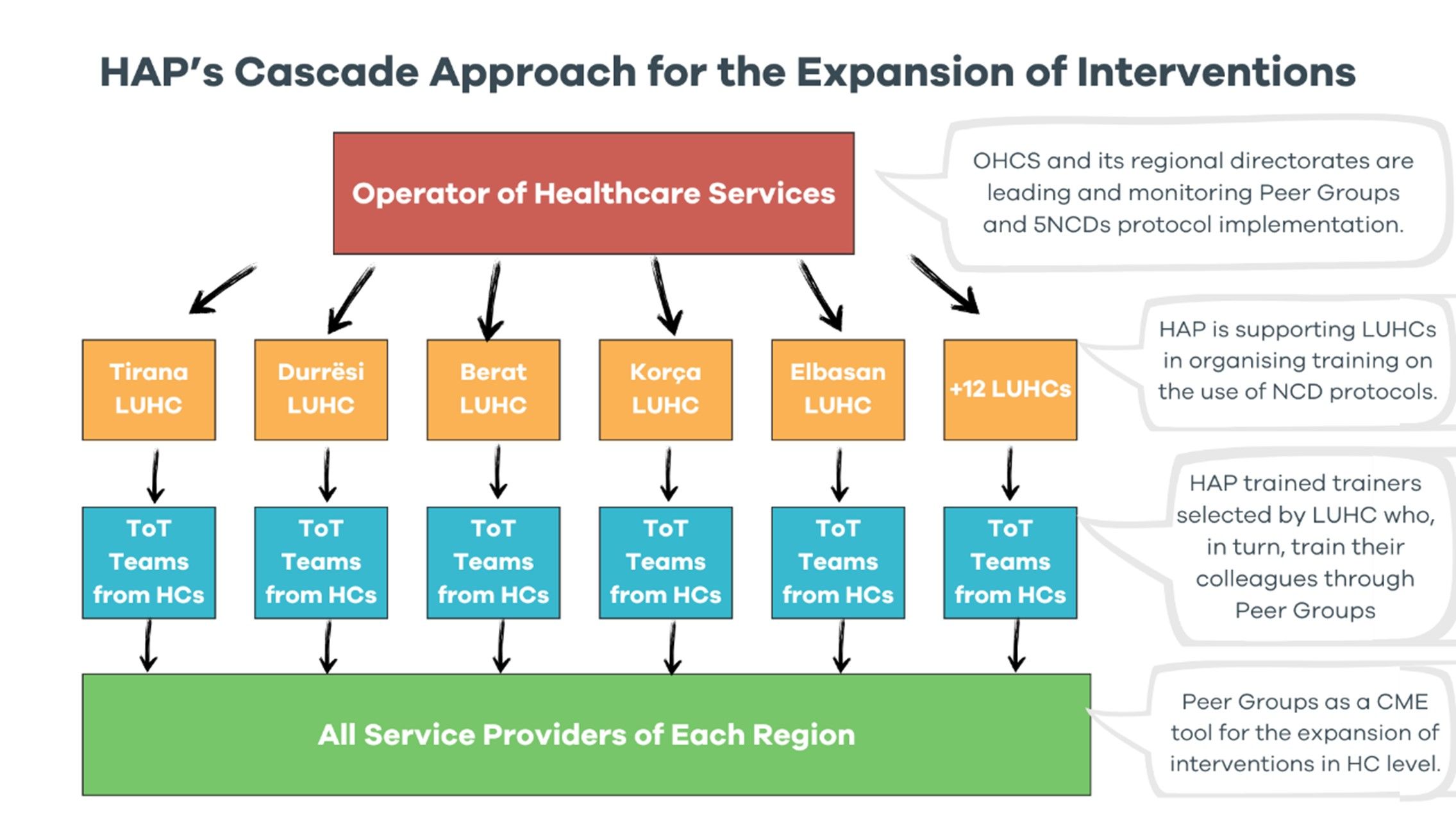
Training and Implementation of NCD Protocols
The expansion of interventions was accomplished in close cooperation with the Operator of Health Care Services, its regional entities, and Local Units of Health Care (LUHCs) by adopting a cascade approach. Practically, HAP supports LUHCs in the implementation of NCDs clinical guidelines and protocols by providing training-of-trainer sessions for a critical mass of trainers who, in turn, continue to train their colleagues through Peer Groups, a continuing education tool introduced and strengthened by HAP. Between 2022 and 2024, HAP facilitated the training of 985 healthcare professionals, including general practitioners and nurses, in evidence-based NCD management protocols. This accounts for 17.5% of PHC providers in project areas. 1,424 professionals (25,2% of the total number of PHC providers) have participated in Peer Groups in the last two years alone, fostering peer learning and widespread adoption of best practices regarding the prevention and management of NCDs.
Equally important for the implementation of protocols in the family team’s daily practice was supplying them with essential examination tools. So far, 136 health centres and 3,033 family doctors and nurses have been provided with medical bags containing physical examination tools and related manuals.
When asked if he had noticed any changes in the patients’ health conditions and quality of life since the implementation of NCD protocols, family doctor Geraldo Krasi from the Duhanas Health Centre in Berat replied with a resounding «Yes!» adding that «the implementation of protocols has led to a noticeable improvement in their health condition and, later, in their quality of life. […] The patients themselves report significant improvement during follow-up visits, and laboratory tests confirm either improvement or the maintenance of their chronic condition under control.»
Moreover, HAP’s investment in rebuilding healthcare infrastructure, in collaboration with municipalities and local authorities, has been a crucial step toward enhancing the quality of care in the community. To date, 31 healthcare facilities have been reconstructed or rehabilitated, benefiting over 240,000 citizens and providing improved working conditions for 432 healthcare providers.
Focus on Elderly and Mental Health Care
Mental health is crucial for the prevention and effective management of NCDs as it interacts with physical health in numerous ways and is a common comorbidity. Mortality from NCDs is two to three times higher among individuals with mental health issues[v].
Recognizing the intersection of ageing, mental health, and NCDs, HAP has prioritised strengthening the capacities of primary care facilities in elderly care and mental health management. In the last two years, a total of 378 PHC providers were trained in elderly care (6,7% of the total number of PHC providers working in areas assisted by HAP), who in turn used Peer Groups to train an additional 560 physicians and nurses (9,9% of the total number of physicians and nurses working in the areas supported by HAP). During the same period, 27 healthcare providers were trained in managing mental health disorders, and they trained an additional 635 physicians, nurses, and psychologists (11,2% of the total number of PHC providers in the areas covered by HAP) through Peer Groups.
By enhancing PHC capacities to address elderly care and mental health issues, HAP is taking important steps to ensure that vulnerable populations receive holistic support for their needs.
Improvement in Quality of Care
Baseline and end-line Quality of Care Evaluations, conducted in 2015, 2018, and 2022, to measure the effectiveness of the Project’s key interventions, showed better outcomes in NCD prevention, treatment and control in the Project’s intervention areas. The findings show a notable improvement in the quality of care from 2015 to 2022 across the three assessed dimensions: doctor-patient interactions, health centers' infrastructure, and patient satisfaction. The patient satisfaction score measured in 2022 was the highest achieved score, compared to the doctor-patient observation and the infrastructure score, across all years and both assessed regions. The overall score increased from 84.6 score points in 2015 to 89.9 score points in 2018 but remained at 89.0 points in 2022, which is still a very high indicator.
The Path Forward
The fight against NCDs in Albania requires more than resources and protocols; it demands cultural and mindset shifts within the primary healthcare workforce. Studies have shown that the successful implementation of NCD management protocols hinges not only on training, but also on changes in attitudes and behaviours among family medicine staff. According to a study by Sibbald et al. (2004)[vi], healthcare workers often require significant time and support to adjust to new care models, with resistance rooted in established routines, limited training, and resource constraints. These shifts, often slow and complex, involve adopting a proactive mindset, embracing preventive care, and fostering deeper engagement with patients. While HAP’s efforts have laid a strong foundation by equipping healthcare providers with tools, guidelines, and peer-based learning opportunities, the long-term success of these interventions will depend on a sustained commitment to behavioural transformation within PHC teams.

References
[i] Plani i Veprimit për Sëmundjet jo të Transmetueshme, Shqipëri, 2021-2030
[ii] Institute for Health Metrics and Evaluation. http://ghdx.healthdata.org/gbd-results-tool
[iii] Institute for Health Metrics and Evaluation. http://ghdx.healthdata.org/gbd-results-tool
[iv] Plani i Veprimit për Sëmundjet jo të Transmetueshme, Shqipëri, 2021-2030
[v] World Health Organization. Noncommunicable diseases. https://www.who.int/news-room/fact-sheets/detail/noncommunicable-diseases
[vi] Sibbald, B., McDonald, R., & Roland, M. (2004). Shifting care from hospitals to the community: A review of the evidence on quality and efficiency