Breaking the vicious cycle of neglected tropical disease and poverty: Addressing social determinants of health is imperative
Imagine that your husband is sentenced to divorce by the highest court in the country while you are pregnant because he has been diagnosed with leprosy.1 Imagine the irony of not getting a government ID because you are indigenous and not recognized as an equal citizen, and that your children suffer from yaws.2 Imagine you are a single mother of two, whose access to quality jobs and education is an uphill battle, due to caste-based oppression, and you’re suddenly at risk of lymphatic filariasis.3 Imagine being sent away from home and not accepted by your neighbors because they (wrongly) believe that your illness stems from your sins and that you are rabid and contagious.4 Now imagine going to sleep stressed and depressed. Let these 5 images sink in for a moment.
Now imagine you, as a public health worker, telling any of these five people who have patches in their skin, that usually does not hurt, that they should go to a clinic few kilometers away for a diagnosis because you suspect leprosy. Or get entire communities to trust you and swallow 9 pills in a row so they can be protected against lymphatic filariasis in a mass administration campaign.
To accept these solutions and to make a lasting impact, it is essential to acknowledge people’s circumstances, ensure mutual respect, and consider the social determinants of their health. This is the core of FAIRMED’s work with communities in the often very remote and neglected corners of the countries. By building this trust with the communities, we achieve lasting change.
But what are these social determinants of health?
There are many frameworks and complex models that try to label them into various groups of categories. At its most profound interpretation and its core, social determinants of health refer to having clean water, clear air, a roof over your head, decent employment, and physical and psychological safety, as being important for . In other words, ill health often is a result of not having access to these basics. It is important to address them, and not just remain focused on medical solutions to diseases. It is even more of critical importance when addressing needs of people affected by neglected tropical diseases or NTDs, because they are often amongst the most economically poor and live in extreme poverty. Just thinking about all these gaps and needs can seem daunting. No one organization or one person, many times not even the government alone can address all of societal needs. Local governments, non-governmental organizations and people of the community have to come together in ensuring their societies create access to these basics.
So how does FAIRMED play a role in addressing these social determinants of health?
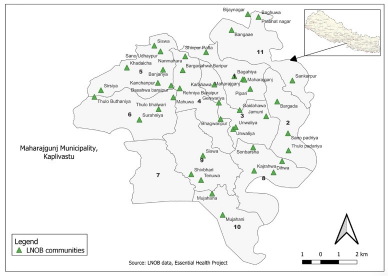
How does FAIRMED bring others along and create an environment to make these access gaps reduce? Here we give an example from Nepal, of a simple yet innovative tool we have created, to complement our role in improving health to further go deeper in tackling these social determinants. We refer to it as the leave no one behind mapping tool. In the districts we work in, based a participatory approach, we engage government and community actors to assess different socioeconomic indicators to identify specific neighborhoods and villages, that are high on the vulnerability index. Some of these indicators include prevalence of child marriage, social stigma and discrimination, presence of marginalized caste oppressed communities, health service accessibility, and ease of access to clean water. This information is then validated with field visits by community mobilizers and volunteers who interact with the communities in these place. Based on these inputs and indicators, we map out in a digital tool, the most vulnerable neighborhoods (see picture below). This we then use as an advocacy tool to bring along partners, local NGOs, local municipality governments and other actors to jointly tackle various gaps. This tool is the one that initiates the bridges that need to be built to improve the social determinants of health. We have had early success stories of using this tool in action. In one of our projects in southern Nepal, in the district of Jhapa and Morang, based on insights from our tool for that region, a local NGO named Sahara, selected these villages for a housing project they were conducting. This enabled 286 locally adapted houses to be built in these vulnerable villages. Another example has been a direct budget allocation for targeted health screening, diagnosis and treatment camps by 4 local municipalities in the Kapilvastu district, where we work.
These early green shoots give us confidence that if we each one of us work together, in a complementary way, miracles do happen, years of neglect do get addressed and lives do get changed for the better.
- Many legal cases in India until recent revocation of this law after long efforts from various actors
- FAIRMED projects in Cameroon include working with the government and the tribal Baka communities to obtain official birth certificates crucial for government services
- Caste-based oppression continues to remain prevalent in India and Nepal where lymphatic filariasis continues to be endemic
- Association of leprosy or many other diseases to past sins is a common sentiment amongst people worldwide and remains so. FAIRMED’s work often involves reminding people that it is a disease that is curable